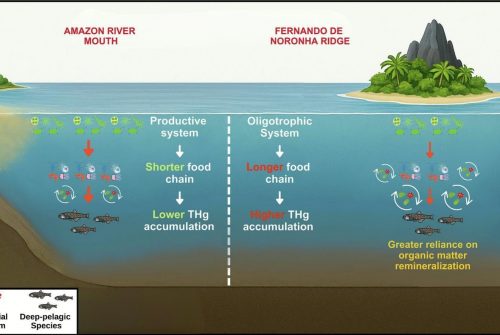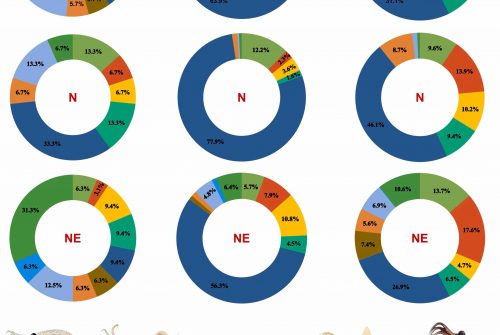
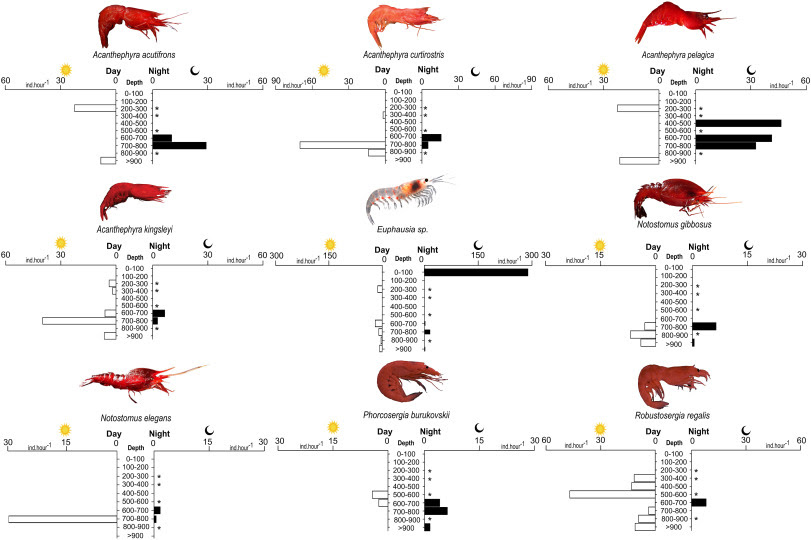
Deep-pelagic crustaceans are integral to ocean functioning, yet their ecological roles remain critically understudied, increasingly vulnerable, and often oversimplified in global models. Here, we investigate the vertical distribution, migratory behaviour, and trophic ecology of deep-pelagic macrocrustaceans (>2 cm; from the surface to 1200 m depth) across two ecologically contrasting regions of the western tropical Atlantic: an oligotrophic northeastern sector off Brazil and a more productive northern sector influenced by the Amazon River plume. Based on net sampling and stable isotope analyses (δ13C and δ15N), we observed distinct trophic positions and vertical niche occupation among the studied taxa, reflecting clear patterns of functional and spatial differentiation. Our results also reveal strong regional contrasts in food web structure: the oligotrophic region exhibited broader trophic ranges and greater isotopic segregation, likely reflecting a longer, microbially-mediated food chain fuelled by limited surface production. In contrast, the more productive region showed a more compressed trophic structure and increased resource overlap, consistent with more direct energy transfer from surface phytoplankton to higher trophic levels. These findings highlight the presence of multidimensional niche partitioning among deep-pelagic crustaceans and underscore the importance of incorporating this ecological heterogeneity into models. As climate-driven shifts in ocean productivity accelerate, recognising these dynamics will be essential for predicting ecosystem responses and informing the sustainable management of deep ocean communities.
DOI: doi.org/10.1016/j.dsr.2026.104680
Reference
Santana J.L., Eduardo L.N., Souza-Filho J.F., Aragão C.E., Andrade R.M., Figueiredo G.G.A.A., Le Loch’c F., Bertrand A. 2026. Vertical migration, trophic structure, and ecological strategies of deep-pelagic crustaceans across contrasting systems in the western tropical Atlantic. Deep Sea Research I, 229: 104680.