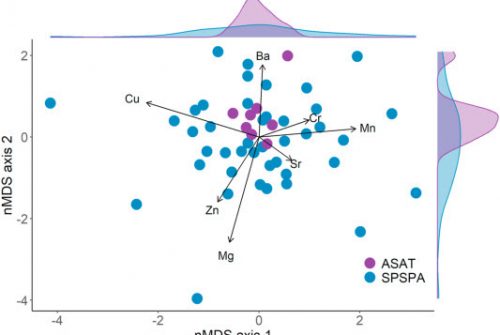
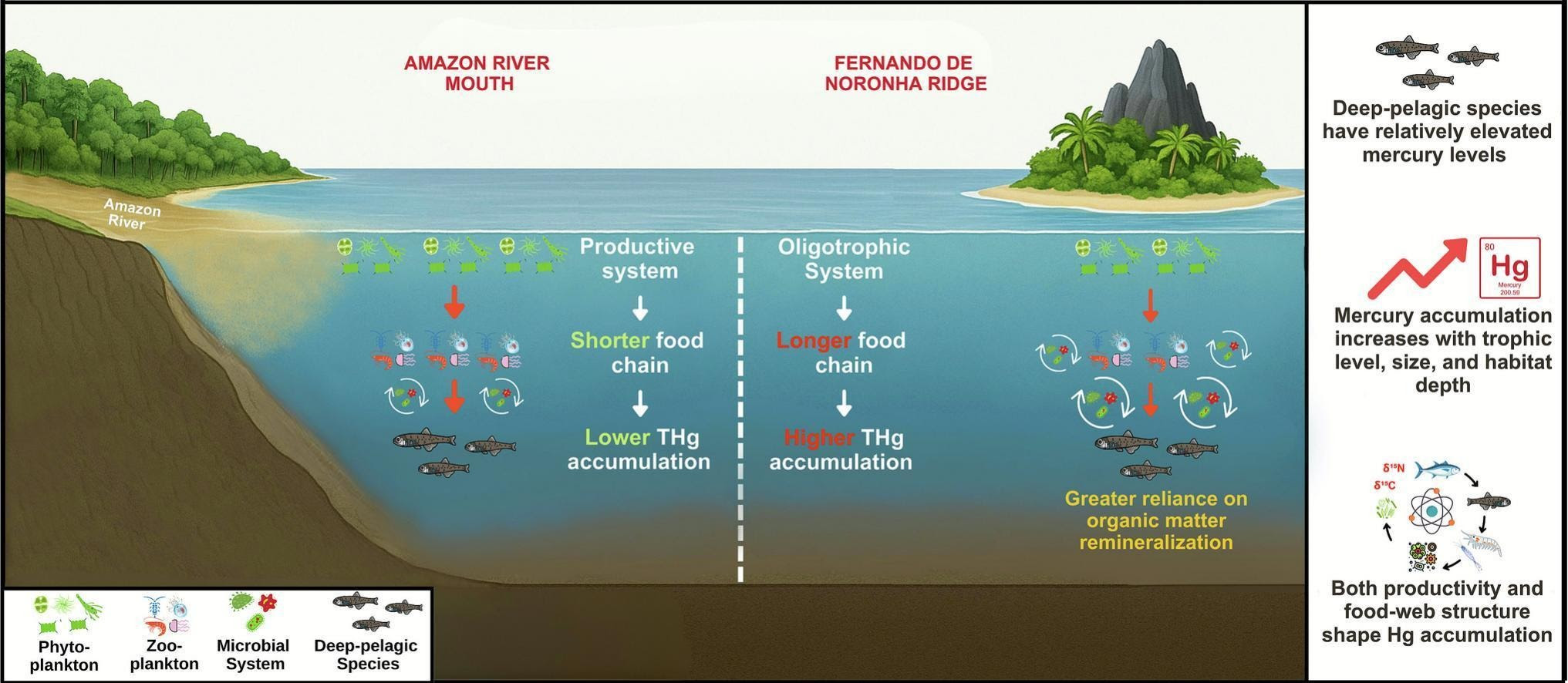
Mercury (Hg) is a global pollutant that poses serious risks to marine ecosystems and human health. In oceanic systems, deep-pelagic species can serve as key prey and major vectors of Hg for large predators such as whales, sharks, and tunas, thereby affecting the health of both wildlife and humans. Mercury accumulation in deep-pelagic communities remains poorly understood, with scarce data and unresolved ecological, biogeochemical, and anthropogenic drivers. Here, we test the hypothesis that ocean productivity drives Hg accumulation in deep-pelagic species. We investigate total Hg concentrations and trophic structure (based on δ15N and δ13C values) in deep-pelagic species across two ecologically distinct regions of the western tropical Atlantic: the oligotrophic waters of the Fernando de Noronha Ridge (FNR) and the more productive off the Amazon River mouth (AMZ). Stable isotope analyses reveal that ocean productivity significantly influences food web architecture. FNR assemblages exhibit a broader δ15N range, consistent with elongated, vertically structured food chains or multiple trophic baselines. In contrast, species from AMZ show compressed δ15N values, indicative of shorter food chains. These trophic differences are mirrored in Hg dynamics. Mercury concentrations were significantly higher in FNR, even when accounting for species size and δ15N values. This elevated Hg burden is likely associated with longer food chains, increased reliance on detritus-based pathways, and synergistic effects linked to low productivity. Across both areas, deep-pelagic species generally accumulate higher Hg levels than ecologically similar epipelagic taxa. Mercury accumulation was also structured along trophic guilds and patterns of vertical distribution and migration. We discuss these results in the context of a changing ocean and their implications for pelagic food web dynamics, providing directions for future monitoring and risk assessment in ocean ecosystems.
DOI: doi.org/10.1016/j.scitotenv.2026.181583
Reference
Eduardo L.N., Médieu A., Bertrand A., Santana J.L., Lucena-Frédou F., Point D., Ferreira G.V.B., Lorrain A., Justino A.K.S., Le Loc’h F., Munaron J.-M., Laffont L., Mincarone M.M. 2026. Ocean productivity and trophic structure drive patterns of mercury accumulation in deep-pelagic fauna. Science of the Total Environnement, 1022: 181583.