

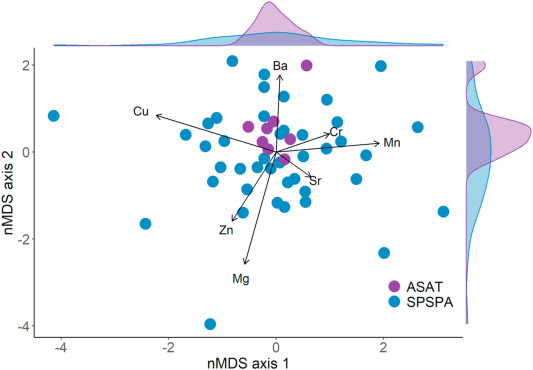
The yellowfin tuna (Thunnus albacares) is a widely distributed species performing long-distance migrations. Along the migratory route, individuals may use critical habitats for feeding and energy replenishment to continue their journeys; these habitats are denominated stopover sites. Such areas are poorly documented for large-bodied migratory pelagic fishes globally and remain unreported in the Atlantic. The objective of this pilot study was to identify the potential role of the Saint Peter and Saint Paul Archipelago (SPSPA) as a stopover site for yellowfin tunas caught off western Africa, using otolith chemistry. Ten pre-adult/adult yellowfin tunas were caught by purse seine fisheries along the Gulf of Guinea. Otoliths from these specimens were chemically analyzed through a core-edge transect. The SPSPA signature – characterized by high concentrations of Zn, Sr, and Ba – was examined along the otoliths. Eight out of ten yellowfin tunas exhibited coinciding peaks of these three elements in their multi-elemental profiles, suggesting passage through the SPSPA. Multivariate statistical approaches supported the hypothesis that yellowfin tunas from the Gulf of Guinea temporarily inhabited the SPSPA. Individuals arrived at the SPSPA at around 0.8 years of age and remained for roughly 5.3 months, thus categorizing the SPSPA as a ‘full-service hotel’ stopover. These findings suggest that the SPSPA plays a key role in the migration of the species and underscore the need for stronger enforcement to safeguard yellowfin tunas at this small, remote, geologically unique archipelago in the Atlantic Ocean.
DOI: doi.org/10.1016/j.marenvres.2026.108045
Reference
Menezes, R., Duponchelle, F., Panfili, J., Queiroz, A. P., Diaha, C. N., Santana, F. M., & Lessa, R. P. 2026. Saint Peter and Saint Paul Archipelago as a key stopover for yellowfin tunas from the Gulf of Guinea. Marine Environmental Research, 108045.