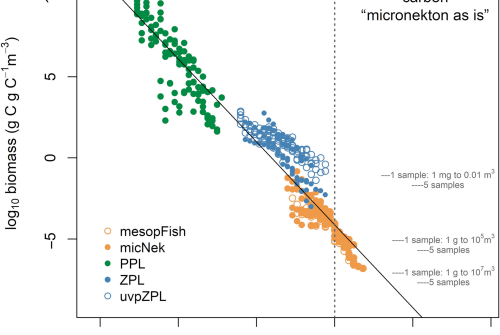
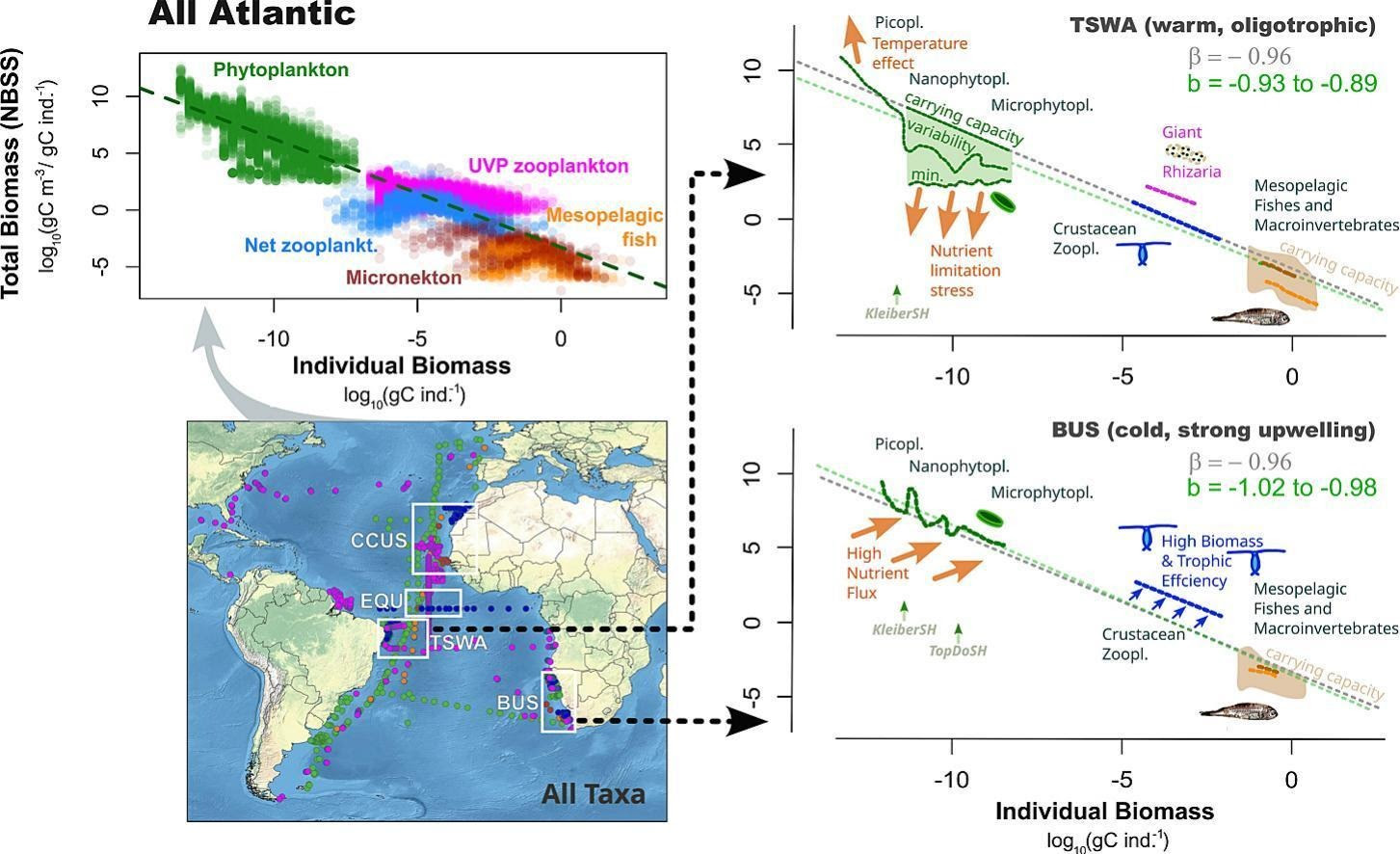
Numerous ambient drivers affect pelagic size spectra, but their relative importance and combined effects are still poorly understood. Here, we present a dataset spanning from picoplankton to mesopelagic fish (across > 15 orders of magnitude), integrating net-caught and in situ imaging data, and encompassing tropical, subtropical, and upwelling systems in the Atlantic. Overall median normalized biomass size spectrum (NBSS) slope was close to −1 (b = −0.955, 95 % CI: −0.960 to −0.949). A sharp peak within the nanoplankton was often found, possibly related to a mesozooplankton grazing size horizon and nutrient dynamics. Phytoplankton biomass fell far below the carrying capacity spectrum in hyper-oligotrophic environments, whereas most other systems were stabilized by top-down control. Nano- to microphytoplankton NBSS slope was not related to sea surface temperature (SST), but to trophic status, with flatter NBSS (i.e., relatively more microplankton) in more chlorophyll-rich waters. Conversely, picoplankton NBSS was positively associated with changes in SST. Picoplankton NBSS was steeper in warm, oligotrophic waters, with high biomass in the smallest picoplankton size classes. While there was also a minor (but significant) negative association with chlorophyll a, SST was the key driver for picoplankton. SST was also important in determining the slope and shape of UVP (Underwater Vision Profiler) zooplankton size spectra. NBSS of net-caught zooplankton was similar to the pelagic ecosystem NBSS. Our findings reveal universal mechanisms regulating pelagic biomass and size structure within the “predator–prey-efficiency theory of size spectra” (PETS), and provide a mechanistic foundation for predicting responses of size-structured communities to global change.
DOI: doi.org/10.1016/j.pocean.2026.103813
Reference
Schwamborn R., Dudeck T., Carré C., Farias G.B., Couret M., Díaz-Pérez J., …, & Bertrand A. 2026. Temperature, trophic state, and carrying capacity govern pelagic size spectra in the Atlantic Ocean. Progress in Oceanography, 103813.