
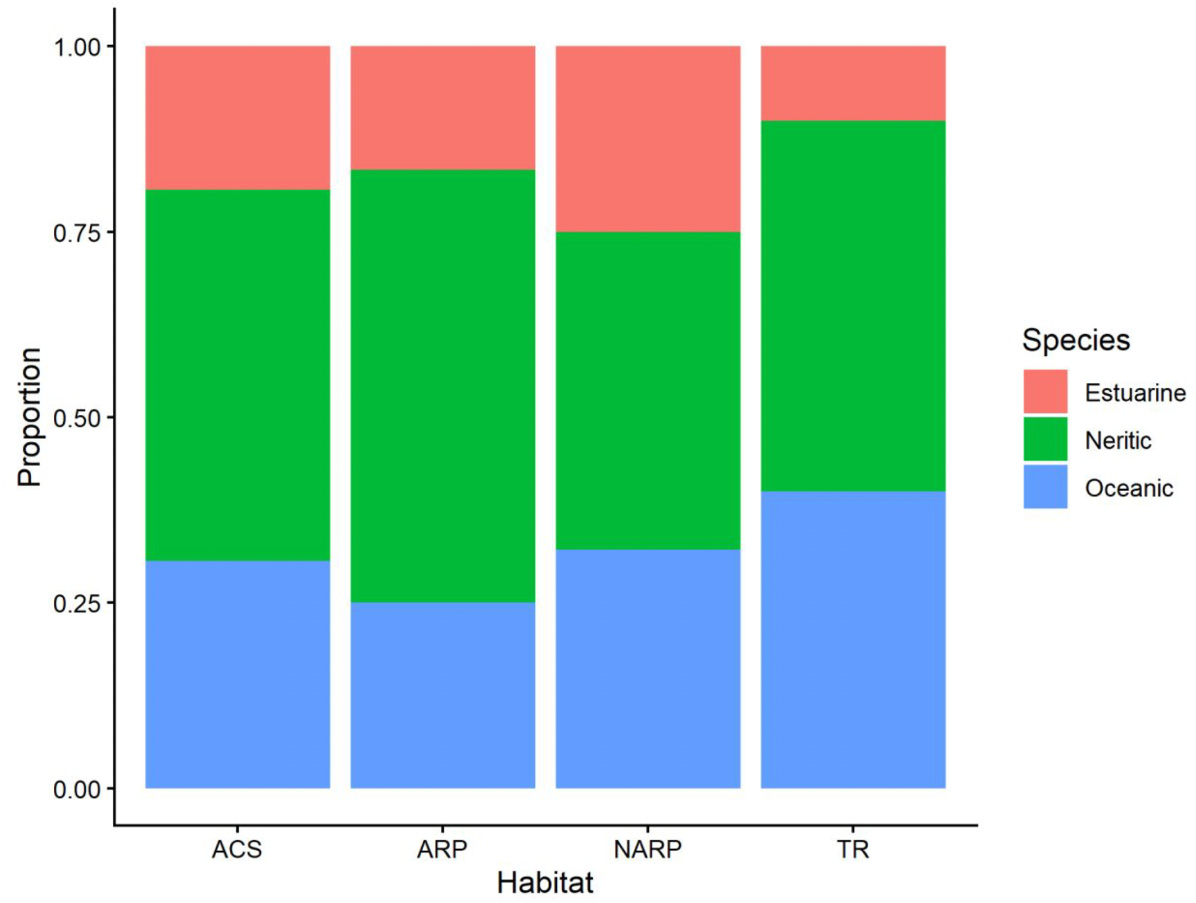
The Amazon River plume (ARP) impacts the Amazon Continental Shelf’s (ACS) marine ecosystem, but its effect on fish larvae remains uninvestigated. To investigate the influence of the ARP on the ichthyoplankton community, MIDI Multinet net integrative tows were carried in the ACS (September 2021) and samples were identified and separated into morphotypes for molecular analysis. Morphological assessment of 343 fish larvae initially suggested 30 families, but subsequent DNA barcoding revealed a 42% discrepancy, highlighting the limitations of traditional taxonomy for larvae identification. Eighty-three fish larvae, representatives of identified morphotypes were successfully assigned to 58 Barcode Index Numbers, including sequences new to global databases and possibly five new occurrences in the region. The assemblage displayed a heterogeneous mix of neritic, oceanic, and estuarine taxa. However, no clear pattern emerged between species life-history traits and their distribution across the plume-generated hydrographic habitats. Although species composition varied across the plume’s influence gradient, our sampling design cannot identify the underlying environmental drivers, underscoring the need for broader seasonal and spatial surveys in the region. These findings reveal the complexity of the ACS ecosystem and demonstrate the necessity of integrating molecular tools to accurately characterize biodiversity gaps and support conservation strategies in this dynamic region.
DOI: doi.org/10.1139/gen-2026-0015
Reference
Pantoja, J. D. S. L., Corrêa, L. D. C., Díaz, X. F. G., Melo, N. F. A. C. D., Hamoy, I. G., Campos, P. N., … & Sá, A. (2026). DNA barcoding of the Amazon Continental Shelf ichthyoplankton: fish larvae assemblages inside and outside of the Amazon River plume. Genome, 69: 1-3.