

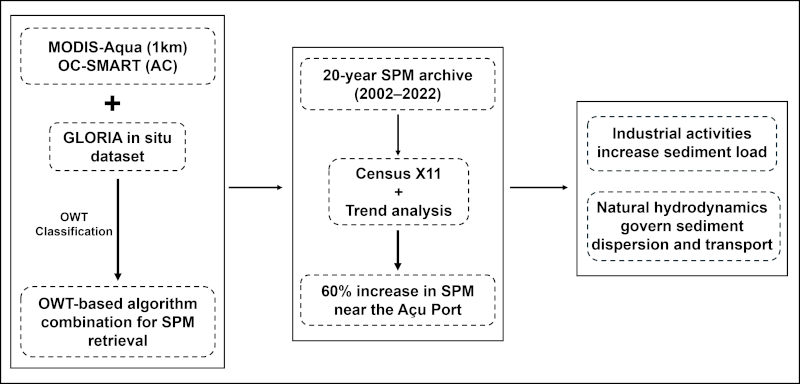
The present study evaluates the influence of industrialization on suspended particulate matter (SPM) dynamics along the northern coast of Rio de Janeiro, focusing specifically on the Açu Port Industrial Complex (APIC). A 20-year MODIS-Aqua (1 km) dataset (2002–2022) was processed using the OC-SMART atmospheric correction. For SPM estimation, a retrieval approach for coastal turbid waters that integrates two optimized bio-optical algorithms based on Optical Water Types (OWTs) was developed. The validity of this approach was substantiated through the utilization of the GLORIA in situ dataset and satellite matchups, which demonstrated its robust performance across a range of turbidity conditions. Its main innovation lies in the OWT-based fusion of two optimized SPM models, enabling robust retrievals across diverse coastal optical conditions. Statistical analyses based on Census X11 decomposition and the Seasonal Mann–Kendall test revealed strong spatial and temporal variability, with SPM concentrations increasing by up to 60% near the APIC during the study period, coinciding with dredging, port expansion, and sediment disposal. These findings indicate a pronounced anthropogenic signal, while spatial and temporal correlation analyses demonstrated that sediment dispersion is consistently directed northward, primarily controlled by currents and wind forcing. The results indicate that industrial activities augment the supply of sediments, while natural hydrodynamic processes govern their dispersion and transport, emphasizing the impact of human pressures and physical drivers on coastal sediments.
DOI: doi.org/10.3390/rs17244020
Reference
Salah Salah, I., Vantrepotte, V., Cardoso dos Santos, J. F., Tran, M. D., Jorge, D. S. F., Kampel, M., & Loisel, H. (2025). Impact of Industrialization on the Evolution of Suspended Particulate Matter from MODIS Data (2002–2022): Case Study of Açu Port, Brazil. Remote Sensing, 17(24), 4020.